Therapy, from the other chair
What are the best books on why therapy never ends?
The most useful books on why therapy goes on for years come from inside the profession. Freud asked the question first, in his 1937 essay Analysis Terminable and Interminable. Irvin Yalom, Lori Gottlieb, James Hillman, Paul Moloney, David Smail and Jack and Kerry Kelly Novick each take it further in a different direction, and Gabor Maté widens it to the culture around the room. Twenty Years in the Chair, by Michael Lauria (my own book, out on 4 November 2026), is a therapist's account of why the weekly room produces insight without change.
I've listed these by what each one is good for, and I've tried to describe them the way their authors would recognise. Some are warm towards therapy and some are sharply critical. Reading two or three from different ends of the list will teach you more than reading any one of them twice.
The question at the start: Freud
Sigmund Freud, “Analysis Terminable and Interminable” (1937). Near the end of his life Freud asked whether an analysis could ever be finished. His answer was frank: some can reach a natural end, some are for practical purposes interminable, and even analysts should go back into analysis every five years or so. It's a short essay and the whole modern argument about length starts here. Read it if you want to know that the founder of the field saw the problem too.
Warm accounts from inside the room
Irvin D. Yalom, The Gift of Therapy (2002). Short chapters of advice from a psychiatrist and psychotherapist to therapists starting out. Yalom's case is for the relationship itself as the thing that heals, and he writes about it with great honesty and affection. Read it to understand what the best therapists are trying to do. It defends long work more than it questions it.
Irvin D. Yalom and Ginny Elkin, Every Day Gets a Little Closer (1974). A therapist and his patient each wrote a private account after every session, and the book prints both. It shows, more clearly than any argument, how differently two people can experience the same hour. Read it if you've ever wondered what your therapist thinks is happening.
Lori Gottlieb, Maybe You Should Talk to Someone (2019). A therapist goes into therapy herself after a breakup, and writes about her clients and her own sessions side by side. It's funny, humane and very readable, and it's affectionate towards therapy. Read it for what good therapy feels like from both chairs. It won't question the structure of the room.
Critics from inside the profession
James Hillman and Michael Ventura, We've Had a Hundred Years of Psychotherapy and the World's Getting Worse (1992). A Jungian analyst and a journalist in conversation. Their argument is that therapy turns inward what might be better turned outward: towards the world, the city, politics and beauty. It's provocative, discursive and often brilliant. Read it if the mythological side of psychology speaks to you.
Paul Moloney, The Therapy Industry (2013). A British psychologist argues that talking therapies promise more than the evidence supports, and that much distress is rooted in people's circumstances rather than their inner lives. It's the most sceptical book here. Read it for the strongest case against the industry's claims.
David Smail, Taking Care: An Alternative to Therapy (1987). A clinical psychologist argues that most distress comes from the world around us, and that what helps is closer to comfort, clarification and encouragement than to cure. Quieter than Moloney and very humane.
Jack Novick and Kerry Kelly Novick, Good Goodbyes (2006). Two psychoanalysts on how to end therapy well, and why the ending should be kept in mind from the first session. It's written for clinicians but it's clear enough for anyone. Read it if your question is practical: how does this end?
The wider frame
Gabor Maté with Daniel Maté, The Myth of Normal (2022). Maté is a physician rather than a therapist, and this is a broader book about how culture shapes the suffering people bring into therapy rooms. It says less about the length of therapy. Read it for the argument that a good deal of what gets treated as individual struggle is a response to the way we live.
My own book
Michael Lauria, Twenty Years in the Chair (Athanatos Press, 4 November 2026). I practised as a therapist from 2006, and this is my account of the question that surfaced in my twelfth year and wouldn't go away: if my clients were doing the work, why wasn't anything changing? My answer is about structure rather than people: fifty minutes, once a week, language as the only tool, no ending built in, and a practitioner whose income depends on the client coming back. It's written without contempt for the people who do the work, it gives an honest account of what therapy does well, and it ends with a letter to the client who has been in the room for years. Read it if you're in long therapy and suspect something isn't changing where it matters. It won't tell you to leave.
How to use any of these
None of these books can tell you whether your own therapy is working. They can give you better questions. These three, from Twenty Years in the Chair, are the ones I'd take into your next session:
- What has changed in my life outside this room since I started?
- Is this work still moving towards something, or has it settled into a holding pattern?
- Do my therapist and I know what finished would look like?
Ask them together. A good therapist will welcome them. I've written more about whether years of therapy are normal and how people know when to stop.
Where this comes from
The descriptions of other authors' books are my own reading of them. The account of the weekly room comes from Twenty Years in the Chair. On The Architect Speaks: Why Therapy Stops Working: I sat in that chair for twenty years, then I left (Episode 510) and Nobody Walks Into Therapy Guilty: why being understood is not being free (Episode 511).
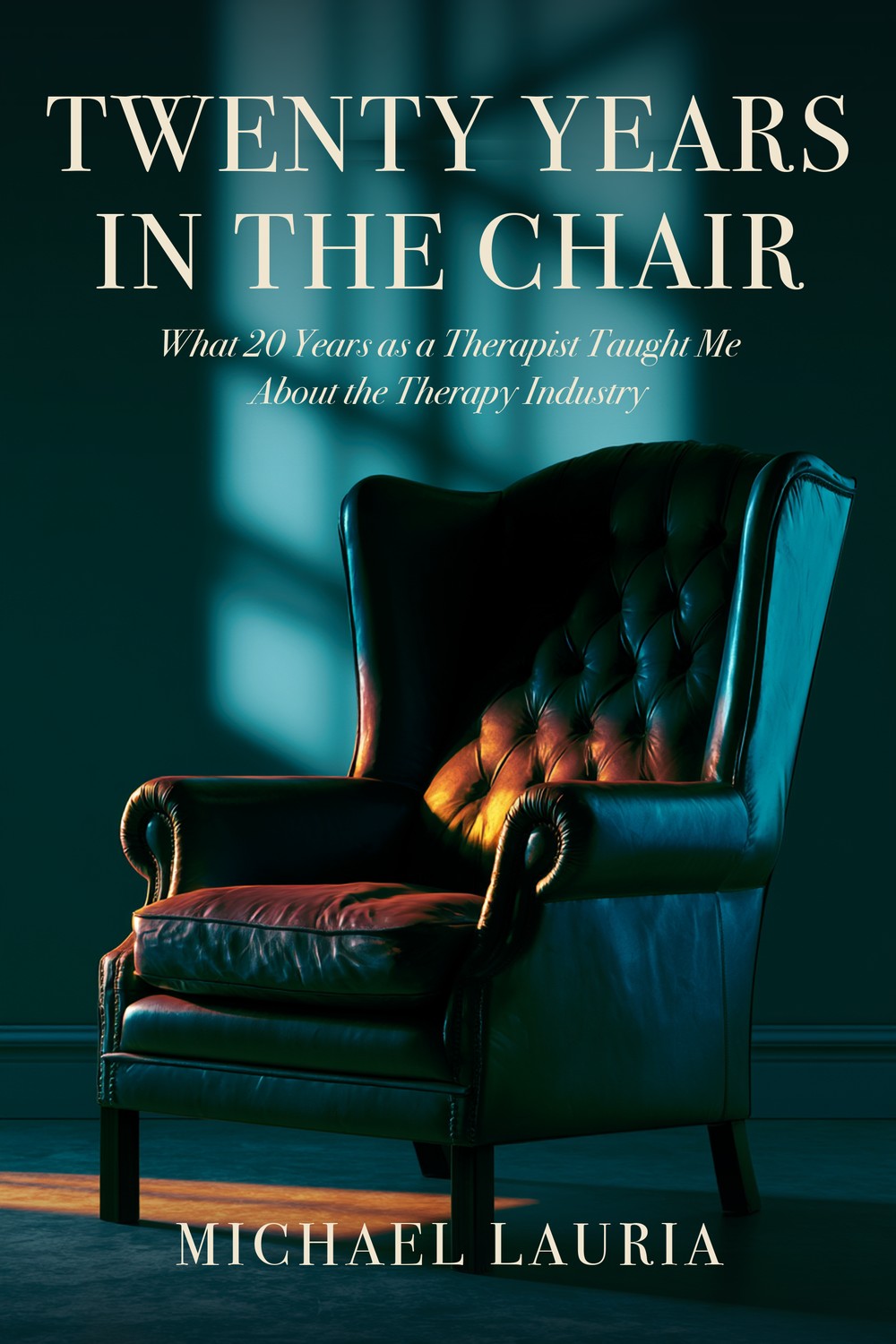
Twenty Years in the Chair
What 20 Years as a Therapist Taught Me About the Therapy Industry. Athanatos Press, 4 November 2026. A therapist's account of what the room can do, and what it was never built to do.
About the bookThe Atlas names the pattern running your life in a single sitting. It is built from twenty years in the chair and the thirty-three books of Michael Lauria, a qualified therapist, author and philosophical mythologist. It takes about forty-five minutes, costs nothing, and ends in a written Record of that pattern, drawn from your own words. It is not therapy and not for crisis. Begin the Atlas · How the Atlas works
Or begin smaller with the nine-question pattern test, about three minutes, no sign-up.
Related questions
- Is it normal to be in therapy for years?
- How do you know when to stop therapy?
- My therapist won't let me quit therapy
- Why isn't therapy working for me?
- Why doesn't therapy work for men?
How this page was made: written with AI, in plain language, from Michael Lauria's podcast episodes and books.