
Before you begin
Is Codex of the Architect a Scam? The Reality Behind the Work
No. Codex of the Architect is the published work of Michael Lauria, a qualified therapist, author and philosophical mythologist: thirty-three books and a podcast of over 550 episodes. Its front door is the Atlas, an AI conversation built from that work. The Atlas is free. It is one sitting of about forty-five minutes and ends in a written Record that you keep. You give a first name and an email address to begin, and no card. Two later steps cost money: the Thread ($130 if you begin within seven days of your Record, $390 after that) and the Witness ($79 a month, for six months at most). Every price is shown before you pay.
If you saw an advert and came here to check before signing in, that's a sensible thing to do. I'm Michael Lauria, and this is my work. Below are the questions people ask before they trust something like this, answered one at a time, with links where you can check.
Who is behind it, and how can I check?
I am. My name is Michael Lauria and I'm a qualified therapist. My qualification is a Diploma of Counselling. I'm not a psychologist or a medical doctor. I was in private practice from 2006, working mostly with men and with couples, and I closed the practice to write and to build this.
You can check that without asking me. My author page links to my books on Amazon and Goodreads, to the podcast on Spotify and Apple Podcasts, and to forgingexcalibur.com, where my first book and my earlier podcast for men are. The thirty-three books are listed on this site, and every episode of The Architect Speaks is free to hear.
If you search my name you'll also find an emergency physician and a medical physicist called Michael Lauria. They're other people.
At first this work went out under the name The Architect, with no author named. That was a choice, and I explain it on For Critics. My name is on all of it now.
Is the Atlas an AI?
Yes. The Atlas is an AI conversation. It asks you a question, listens to your answer, and within your first few answers names the pattern it hears underneath. When you finish it writes your Record, a few pages in plain language drawn from your own words.
It's built from my own work: the thirty-three books and over 550 podcast episodes. It runs on commercial AI models from outside providers, and the privacy policy says how.
A general chatbot is built to keep you comfortable, so it tends to agree with you. I talk about that in Episode 510. The Atlas is built to be accurate. It won't flatter you, and you can tell it when it's wrong.
It is not therapy and it is not for crisis. It doesn't diagnose, and nothing it says is medical advice. If you're thinking about harming yourself, or you're not safe, go to a person first. In the US, call or text 988. In the UK and Ireland, Samaritans are on 116 123. In Australia, Lifeline is on 13 11 14.
If you want a person at any point, reply to any email it sends you and a human will answer. There is more on how it works at What is the Atlas?
Did AI write the books?
I could tell you it didn't. So could anyone, which is why my saying it proves nothing.
Here's what I can tell you. The books have my life in them. The Death of the Savior, Beyond Attachment, The Descent of the Hero: my own failures are in those pages, and the years I got it wrong, and what twenty years in the room taught me. No machine was there for any of that.
I did use AI, the way most writers now do, for the jobs an editor and a typesetter would do: putting my material in order, correcting the spelling, grammar and punctuation, smoothing the flow, and laying out the pages. Done by hand, that work would have kept the books from readers for another year or two.
So don't take my word for it. Read one. Before Approaching the Threshold is free and comes with your Record. The others are listed on this site, and they open to you inside the app when you finish the Thread. Read a few pages and ask yourself one question: does this describe my life? If it does, you'll know somebody who has been there wrote it. If it doesn't, put it down. I talk about all of this in Episode 479, Is This Real or AI?
What happens when I sign in?
You give a first name and an email address. There's no password to create and no card to enter. The email is where your Record is sent, along with a free book, Before Approaching the Threshold. Before you send your first message the screen says who it isn't for: by sending it you confirm you're eighteen or over and acknowledge that it isn't therapy and isn't built for crisis. If you have to stop part way, entering the same email again sends you a link back to where you were.
It doesn't have to be your real name. A single letter will do. The email can be one you keep just for this, or a masked one like Apple's Hide My Email, as long as you can open it, because that's where your Record goes. The Atlas works the same either way.
Why is it free? What's the catch?
The Atlas is the front door, and the Thread is the paid step behind it. In marketing terms that's a funnel, and I'd sooner say so than leave you to work it out.
The free part is whole. Your Record is yours whether or not you ever come back, and nothing turns into a charge later. Most people who finish the Atlas stop there.
After your Record you'll be told about the Thread, on screen and in emails over the following days. You can unsubscribe from those with one click.
Every step and every price is on one page, The Whole Path. There are three steps and then it ends. It's built to make itself obsolete for you.
What costs money, and how much?
- The Atlas, your Record and the book Before Approaching the Threshold: free.
- The Thread: $390. Finishing the Atlas earns you a $260 credit, so it's $130 if you begin within seven days of your Record. It's five sessions of about thirty minutes, one a day, and a written report at the end.
- The Witness, for people who have finished the Thread: $79 a month. You can cancel whenever you like, and it runs for six months at most. Before any of that you get one free forty-five minute session.
- Guided options, where the Witness comes with time on Zoom with me: $295 or $495 a month.
- The books on their own: $9 each for most of them, in the Library.
Prices are in US dollars. Payment is taken by Stripe, the price is on the screen before you pay, and I never see or store your card details.
What happens to what I type?
It's stored on your account, with the Record or report made from it, so that each step can pick up where the last one ended. It stays there until you ask for it to be removed.
To write a reply, your words are sent to an AI model through a service called OpenRouter. We choose model providers that don't use your words to train their models.
Your conversations and your Record are not sold, and they are never used for advertising.
Access is limited to the people and processes needed to run the service. What you write is likely to include things about your mental health, which the law treats as a special category of data, so it's processed only with your consent and only to deliver the work to you.
You can delete your account from your account page. That removes your name, your email address and your sign-in, and leaves the conversation with nothing that identifies you. If you want the conversation itself erased, write to signal@codexofthearchitect.com and it will be. The company that runs it is registered in the UK, so UK data protection law applies, and you can complain to the Information Commissioner's Office if you think we've handled it badly. The full privacy policy and terms are on the app.
Can I get my money back, or cancel?
The Atlas is free, so there's nothing to refund and nothing to cancel.
The Thread is refundable in full at any time before your first session starts. Once the first session has started, it isn't.
The Witness can be cancelled whenever you like from your account page, under Manage Billing. It stops at the end of the month you've paid for, and months already paid aren't refunded.
If you don't cancel, it ends by itself after your sixth monthly payment.
If you think you were charged wrongly, or something you paid for didn't arrive, write and it will be put right.
Is this too good to be true?
It would be, if I told you that forty-five minutes would change your life. I don't.
What the Atlas does is narrow. It names one pattern, in your own words, and shows you where it appears across your life. Many people already understand themselves well and have never seen that one pattern whole, and that is what it's for.
Seeing a pattern is not the same as being free of it, and I say so on the page that offers the Thread. The paid steps exist because seeing is only the first part.
It can get things wrong, and you can push back when it does. It comes out of clinical observation over twenty years, which is the standard depth psychology has always worked to, and I answer the evidence question in full on For Critics. If you want a person sitting across from you, a good therapist is the right road. And I make no promise about what will be different in your life afterwards. That part is yours.
What do critics say, and where do you answer them?
The ones I hear most: that there's no evidence base, that the framework can't be falsified, that it's survivorship bias, that it could be turned on other people as a weapon, and that publishing as The Architect was a way to avoid accountability. I've answered thirteen objections one at a time on For Critics, and recorded a podcast episode, For The Critics.
My position there is short. These are maps. Test them. If they don't fit your experience, discard them, and if something better exists, use that. The one thing I ask of a critic is to engage with what the work actually says before judging it.
Why do I keep seeing ads for it on Facebook and Instagram?
Because I pay for them. Most people have never heard of me, and adverts are how the Atlas reaches someone who isn't looking for it.
How do I test it before believing anyone?
Sit the Atlas. It costs nothing, there's no card, and it takes one sitting of about forty-five minutes. Then read your Record and ask whether it describes you. If it doesn't, you've spent three quarters of an hour and you owe nothing.
If you'd like a smaller first step, the nine-question pattern test takes about three minutes and needs no sign-up. You can also listen to any episode of the podcast before you give an email address to anyone.
What do I do if something goes wrong?
Reply to any email you've had from the Atlas, or write to signal@codexofthearchitect.com. A person answers. If you have an account, there's also a Support page inside the app, for a question, a problem or a refund. If a Record didn't arrive or a charge looks wrong, say what happened and it will be sorted out.
Where I've said this on the podcast
- The Anatomy of This Work: how the whole body of work is built, what is the core and what sits around it. In it I say it was never designed to create followers.
- For The Critics: my answers to critics, spoken. It ends on the same invitation: test the frameworks, and discard them if they don't fit.
- Why Therapy Stops Working: I Sat in That Chair for Twenty Years, Then I Left (Episode 510): why I closed my practice, why a chatbot will agree with you, what I built, and who it is not for.
- Is This Real or AI? (Episode 479): the suspicion that everything is AI now, and how I used AI to compile the thirty-three books.
- Is It Bad to Have an AI Companion? (Episode 482): what an AI that can't disappoint you is unable to give you, and how to use one without letting it replace people.
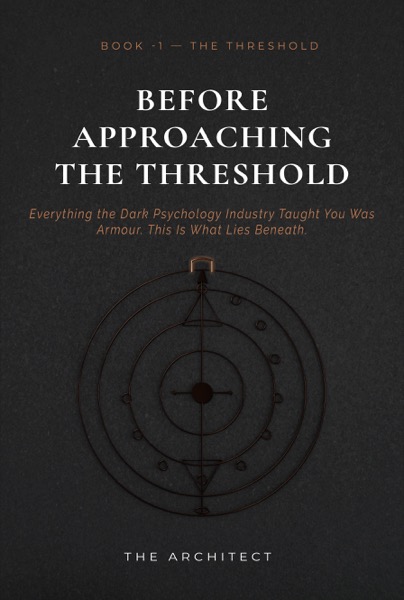
Before Approaching the Threshold
Why self-help hasn't worked, and what lies beneath it. The free book of the Codex of the Architect. The personal development industry sells scaffolding and calls it the building.
About the free bookThe Atlas names the pattern running your life in a single sitting. It is built from twenty years in the chair and the thirty-three books of Michael Lauria, a qualified therapist, author and philosophical mythologist. It takes about forty-five minutes, costs nothing, and ends in a written Record of that pattern, drawn from your own words. It is not therapy and not for crisis. Begin the Atlas · How the Atlas works
Or begin smaller with the nine-question pattern test, about three minutes, no sign-up.