
The pattern beneath
Why doesn't manifestation work for me?
Manifestation doesn't work for you because it tries to change your thoughts without ever looking at what writes them: a structure installed long before you owned a vision board. The parts of the “science of manifestation” that hold up all work through what you actually do, and none of them reach that structure.
I take the science claims one at a time in Episode 544 of The Architect Speaks.
Did you write the affirmation every morning, keep the vision board where you'd see it, and still wake up in the same life, making the same choices? And did you start to suspect the fault was yours?
I took the general question, does manifestation work at all, claim by claim in Episode 544 of The Architect Speaks. This page is for the personal version: you did what was asked, and nothing changed. Twenty years of sitting with people desperate for their lives to change sent me looking for the science of manifestation as soon as book covers started promising it.
Is manifestation real scientifically?
Most of the physics in it is borrowed in name only. The observer effect gets used as proof that your attention shapes your reality. In quantum physics, the observer is whatever measures the particle, such as a detector or a single particle of light. As far as I can see, no experiment has shown that wanting a result changes what the particle does. Frequency has a number you can measure. Nobody has ever put a number on your vibration.
Some of the psychology is real. The reticular activating system gets explained with the new car effect: buy a blue car and suddenly there are blue cars everywhere, though the roads had just as many the week before. Psychologists call that selective attention, and it's well studied. I wrote many years ago that you don't attract your reality, you filter it, and I still think that's the accurate version.
Expectation is real too. People who believe they can do something often try harder and keep going longer. A sugar pill can ease pain and nausea, though a placebo has never mended a broken bone. Writing down a clear goal, with a plan for when and where you'll act on it, makes people more likely to follow through, and that's called planning. Every part of this that stands up in research works through what a person actually does. None of it shows the universe answering your thoughts.
Does manifestation work without action?
One body of research suggests the central practice can make things worse. Gabriele Oettingen, a psychologist at New York University, spent much of her career studying people who picture the future they want. In one study, women in a weight-loss programme who daydreamed most about being slim had lost fewer pounds a year on. In another, graduates who imagined getting a better job most positively were doing worse at getting into work two years later. Across her experiments, people led to picture a perfect outcome had less energy for the task straight afterwards.
Her explanation is that the mind takes the picture as a taste of having arrived. So the push to go and get the thing actually drops away.Michael Lauria, The Architect Speaks, Episode 544
She also found what works, which she calls mental contrasting. You picture the main thing, in you or in your life, that stands in the way, and people who did that put in more effort and got better results. That's the step the manifestation industry skips.
A 2023 study from the University of Queensland looked at more than a thousand people, over a third of whom believed in manifestation. The believers saw themselves as more successful, but risky investments also appealed to them more, and more of them had been through bankruptcy. The study can't say the belief caused that, but the pairing makes sense to me: if wanting it is what delivers it, you've no reason to ask what it'll take from you.
Why does my life stay the same when I manifest?
Manifestation says change the thought and the life will follow, and it never asks what wrote the thought. By the time you're old enough to sit down with a vision board, most of what decides your choices was put there years earlier, before you could consent to what went in. One child learns that wanting things out loud causes trouble at home, and stops asking for anything.
I call this the architecture, and it's still running in the adult. It generates the wanting and writes the doubt that follows it. Once you get close, it writes whatever undoes the result too. So when you write “I am worthy of love” on a note on the mirror, the words land on an older instruction that says love is kept by never asking for anything.
The architecture doesn't respond to affirmations because it was installed before language, because it doesn't believe words that it didn't experience. That's why the good feeling from the morning practice is usually gone by lunchtime and why people end up doing the practice every day for the rest of their lives.Michael Lauria, The Architect Speaks, Episode 544
I've done this myself, and I've taught it. In Forging Excalibur, an earlier book of mine written for men, I told readers to write an affirmation 25 times a day for 60 days. I'd done it first, while going through a divorce and feeling I was failing miserably as a father. My line was “I'm the best version of a father I can be for my children,” and by the middle of the second week I was struggling to believe it. My mentor kept me at it, and things did change.
In the book I wrote that it felt like magic, and in the same passage that what had really changed was the way I responded to the world around me. That second part was the true one, because the repetition kept me steady and kept me showing up. What I never asked was what had written the feeling of failing into me, long before I was anyone's father.
Is it my fault my manifestation didn't work?
When it doesn't work, the method has an answer ready. You didn't believe hard enough, or your vibration wasn't aligned. In some circles you're told you attracted your own failure. I worked with a woman who spent years in communities that told her to raise her vibration and focus on the light. All that time she was in an abusive relationship and struggling to get through each day.
She told me in her own words, “They kept telling me I was creating my own suffering with my negative thoughts. So I sacrificed my right to acknowledge that I was actually suffering.” That's what the blame does. It asks people to give up the truth about their own lives so they can keep the method.Michael Lauria, The Architect Speaks, Episode 544
You did what was asked, and you wanted it enough. The method itself asks you to think your way past the thing that's doing the thinking.
What do I do when manifestation doesn't work?
The word sacrifice in that woman's sentence is the centre of all this for me. Every choice gives something up to get something else, and whether that sacrifice is coherent or incoherent decides the life you live. Coherent sacrifice is giving something up for what's really yours. Incoherent sacrifice is giving yourself up for something handed to you, usually when you were too young to refuse it.
Manifestation promises you the relationship or the work you want without the sacrifice. Anything real you want will ask you to give something up. It might be the familiar version of yourself everyone's used to, or the approval of a parent you've been working for since you were seven. Meanwhile the old sacrifices, the ones you made as a child to stay close and stay safe, go on being made underneath the affirmations.
What manifestation can honestly give you is relief, and on some days a glimpse of the structure you're living inside. People can see their pattern with complete clarity and go on living it, because the architecture doesn't run on understanding. I've written about why knowing your pattern doesn't change it. What changes it is lived experience that contradicts what it was put there to protect you from. That means asking for something and finding the relationship holds, or stopping being useful for a week and finding you're still loved. It happens one real situation at a time.
Before you go back to the practice, take one thing you've tried to manifest more than once and ask yourself what having it would really ask you to give up.
The Atlas looks at what manifestation leaves out: it names the pattern that's been writing your thoughts, from your own words, in a single sitting. Begin the Atlas.
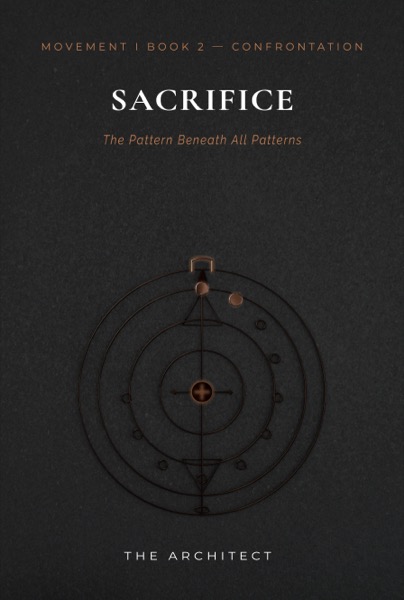
Sacrifice: The Pattern Beneath All Patterns
Every choice read as a sacrifice, and every symptom as the cost of sacrificing incoherently. One of the thirty-three books of the Codex of the Architect.
About the bookQuestions people ask
Do Masaru Emoto's water crystals prove manifestation?
No. Masaru Emoto, a Japanese author, photographed frozen water and said that water spoken to kindly formed beautiful crystals, while water that was insulted formed ugly ones. The photographers chose which crystals to photograph, and the results have never been repeated under independent, controlled conditions. It still gets passed around as proof of the science of manifestation.
Does the heart's electrical field attract what you want?
The heart does give off a small electrical field, and instruments can pick it up very close to the body. That much is real. The claim built on top of it, that this field reaches out into the world and arranges events for you, has never been shown. It's a real measurement carrying a meaning nobody has demonstrated.
Does the reticular activating system explain manifestation?
It explains why you start noticing things once you're looking for them, which psychologists call selective attention, and that part is real. What the talk about it leaves out is what's giving the filter its instructions. In my work that's the architecture, the structure installed when you were young. It decides what you look for, and the filter carries that out. Naming the mechanism tells you nothing about who set it.
The Atlas names the pattern running your life in a single sitting. It is built from twenty years in the chair and the thirty-three books of Michael Lauria, a qualified therapist, author and philosophical mythologist. It takes about forty-five minutes, costs nothing, and ends in a written Record of that pattern, drawn from your own words. It is not therapy and not for crisis. Begin the Atlas · How the Atlas works
Or begin smaller with the nine-question pattern test, about three minutes, no sign-up.
Listen to the episode
- Does Manifestation Work? The Science of Manifestation (Episode 544) on The Architect Speaks
- Watch it on YouTube