A book by The Architect
The Codex: The Unexamined Reality
The final book of Movement II. The complete architecture of capture: one mechanism, three operations, running identically in every institution you have ever inhabited.
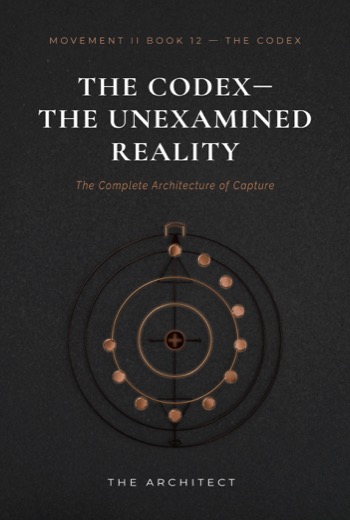
It is one mechanism. Eleven books examined eleven separate domains: religion, history, education, money, the state, law, medicine, the family contract, the captured body, the managed self. Each landing was real. What you are holding now is what those examinations were building toward. Not a twelfth institution opened and turned over, but the blueprint every institution was built on: absorption of a genuine need, removal of direct access to it, enforcement of the institution as the necessary intermediary. You felt it eleven times before this book named it. The map of the entire territory, laid flat, visible at once.
What is inside
The pattern. The three operations in full: how absorption works less by deceiving people about what they need than by becoming the only visible path to what they already know they need. How removal is not censorship but the disappearance of the alternative from the field of the imaginable. How enforcement is internalised before it is ever external, so that the prisoner polices the cell for free.
The domains, consolidated. Chapter by chapter, the mechanism traced through the sacred, the narrative, the institution, the economy, the body, the relation, and the perception. Each domain's capture shown as one instance of the same architecture, wearing a different costume.
The interconnections. The closing chapter maps how the captured domains reinforce one another, so that the curated reality holds together as a single structure rather than a collection of separate problems.
Who it is for
The reader who wants the map of the whole territory rather than another tour of one room. The man who has worked through the Movement II examinations and wants the convergence, and the man who has not yet read them and wants to see the complete architecture before committing to the depth. Both arrive at the same place: the mechanism visible, portable, pointed at whatever system he encounters next.
Naming the mechanism is not discovery. It is clarity about what you already know. What you do once you can see it is the question the book leaves in your hands.
Want to feel the work before you read it? The Atlas takes one true thing you are carrying and shows you the structure underneath it, free.
Open the AtlasRead about the framework behind the book.